Beijing, Sept 07, 2026 - As the era of 10,000-GPU clusters arrives, AI computing networks are carrying massive volumes of RDMA traffic over RoCEv2. RDMA has virtually zero tolerance for packet loss. A single packet loss event can cause a dramatic drop in training performance. That is why AI computing networks must be lossless. But a lossless network cannot be achieved simply by stacking up switch specifications. It has to be tested.
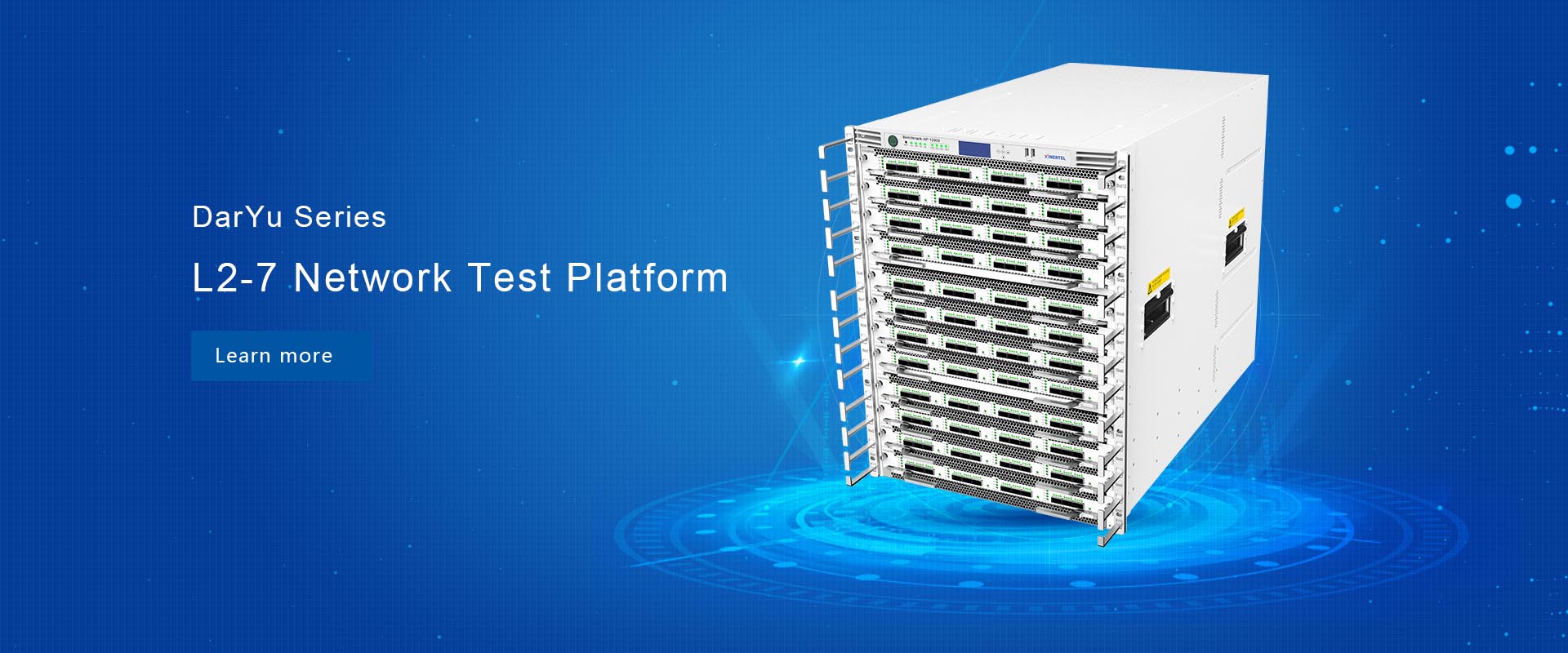
Xinertel’s DarYu Series 800G Testers support RoCEv2 RC (Reliable Connection) traffic and CCL (Collective Communication Library), ECN + DCQCN congestion control validation, and PFC lossless flow-control testing—covering critical validation scenarios from R&D to network acceptance.
RC & CCL: Can Your 800G Network Handle Real Training Traffic?
Production RDMA environments primarily use RC mode, where one-to-one QP connections provide reliable and ordered delivery through hardware mechanisms. The DarYu 800G can emulate RDMA endpoints and establish RC connections, enabling network devices to be tested under large-scale QP concurrency for forwarding performance and reliability.
Going a step further, DarYu 800G integrates CCL collective communication algorithms and operator emulation, bringing realistic cluster communication patterns directly into the test environment. Equipment vendors can use realistic gradient-synchronization traffic to evaluate the true forwarding capacity of their switches. AI computing centers can complete network pre-acceptance testing before GPUs arrive, significantly accelerating deployment. Network teams can compare communication efficiency across different topologies and network configurations, using data to guide network design.
ECN & DCQCN: Make the Dynamic Battle of Congestion Control Visible
The essence of a lossless network is not to simply "stop the traffic," but to manage congestion intelligently. When queues begin to build up, ECN marks packets. The receiving NIC then uses the DCQCN algorithm to rapidly reduce its sending rate and gradually recover. Set the threshold too low, and throughput suffers. Set it too high, and congestion can lead to packet loss. There is no completely universal configuration. Actual testing is a must.
DarYu 800G makes the entire process measurable and transparent:
1. ECN threshold scanning
Validate ECN marking thresholds step by step, quantify throughput, latency, and packet-loss curves, and confirm that ECN is triggered before PFC.
2. DCQCN behavior validation
Emulate endpoint NIC behavior and visualize the complete rate-reduction and recovery process under burst congestion, providing quantitative data for parameter optimization.
3. Incast stress testing
Reproduce the most demanding congestion scenarios found in collective communication and compare flow completion time and fairness across different solutions.
PFC: The Last Line of Defense for Lossless Networking
PFC is the final safeguard of a lossless network. But improper configuration can trigger PFC storms, head-of-line blocking, and even network-wide deadlocks. Using DarYu 800G test modules to create an Incast many-to-one congestion model and apply 101% line-rate traffic load, you can precisely validate three critical factors: Is the PFC trigger threshold timely? Does backpressure propagate correctly hop by hop? Is the headroom buffer sufficient? Precision braking—or network-wide paralysis? Testing tells you the difference.
800G AI Networks: Performance Starts with Precision Testing
The competition in 800G AI computing networks is ultimately a competition in deployment quality. And deployment quality always starts with accurate testing.
From complete RoCE lossless-network validation to realistic CCL collective communication emulation, Xinertel DarYu X2-800G test modules support the DarYu3000 and DarYu12000 chassis, while the X5-800G all-in-one tester provides a dedicated solution for evolving AI network architectures. The DarYu 800G platform also delivers comprehensive capabilities for full-scenario 800G network testing:
• Native QSFP-DD and OSFP 800G interfaces
• Flexible multi-rate configurations: 1×800G, 2×400G, 4×200G, and 8×100G
• Large-scale L2/L3 traffic generation and routing/switching protocol emulation
• Support for BGP, OSPF, IS-IS, SR, VXLAN, EVPN, and other mainstream protocols
• Full benchmark testing with RFC2544, RFC2889, RFC3918, and Y.1564
• Up to 32K flows per port for traffic generation and statistics
• Real-time visibility into packet loss, out-of-order packets, latency, and jitter
• Seamless test automation through the Renix test platform, Tcl, and Python APIs
The X2-800G test module is compatible with DarYu3000 and DarYu12000 chassis, enabling seamless expansion of existing test platforms. The X5-800G all-in-one tester is available in 4-port and 8-port high-density configurations, providing an out-of-the-box solution for 800G network testing.
RoCEv2 carries the critical traffic behind AI training. 800G is becoming the foundation of next-generation AI computing networks. Xinertel brings comprehensive lossless-network validation and CCL collective communication emulation together in one testing solution—so every step forward in 800G AI networking can be validated with data and delivered with confidence.